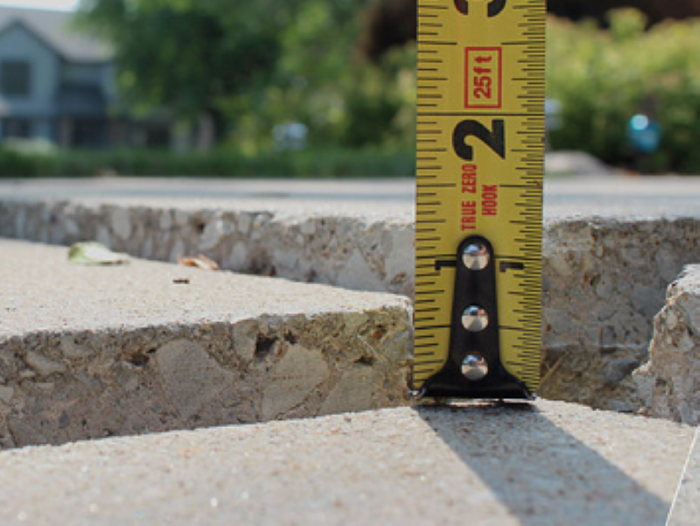
You feel it before you name it. A thunk as the front tires cross the garage threshold, then a second one from the rears. It used to be nothing. Now you slow down for it, and you have started noticing the line of grit and water that sits just inside the door after a storm.
That is the garage apron settling, and it is one of the most-driven-over and least-talked-about slabs on a property. Before going further, one clarification that saves confusion: this post is about the exterior apron, the section of concrete between your driveway and the garage door opening. If the concrete inside the garage has dropped, that is a different slab with a different access approach, and we cover it in lifting a sunken garage floor with polyurethane foam. The two problems look related from the driver’s seat and are handled separately in practice.
Idaho Concrete Lifting sees a rush of apron work every year between first frost and first real snow, for reasons that become obvious below.
What the apron is, and why it behaves differently
The apron is the transition slab at the garage entrance. It is usually poured separately from both the driveway and the garage floor, sitting right at the foundation line where the building’s footing ends and the yard begins.
That location is the entire problem. The apron is poured over the backfill trench excavated when the foundation was built. The garage floor inside is generally supported by compacted base within the foundation walls. The driveway further out sits mostly on undisturbed native soil. The apron is the one slab in the sequence resting on the loosest ground on the property, and it carries every vehicle that enters or leaves.
So it drops, and because the garage floor behind it does not, you get a step. The apron settles away from the building while the floor stays put, which is why the bump is almost always at the door line rather than out in the driveway.
Why the apron settles when the driveway does not
- Backfill consolidation. Loose fill in the foundation trench keeps densifying for years after construction, and it is never uniform across the width of the opening.
- Concentrated roof runoff. The garage roof sheds a large area of water toward a short stretch of ground, often through downspouts that discharge within a few feet of the apron.
- Repeated point loading. Every vehicle on the property crosses this slab, and it does so with weight transferring as tires roll across the joint.
- Freeze and thaw at the building line. Water pooling at the apron edge soaks the backfill, freezes, heaves, thaws and leaves a slightly larger void behind.
- The slab is often thinner than the driveway, because it was poured as a transition piece rather than a load-bearing surface.
If the settlement is out in the driveway body rather than at the door, the diagnosis and the fix are different, and our post on signs your driveway needs lifting is the better starting point.
What the bump is actually costing you
Water running back into the garage
This is the expensive one. A correctly built apron pitches away from the building so water sheds to the driveway. Once the apron settles, that pitch flattens and then reverses. Now rain, snowmelt and the slush dropping off your vehicle all run toward the door instead of away from it. Water gets under the door seal, onto the garage floor, and against the bottom of the foundation wall, where it soaks the same backfill that caused the problem and makes the settlement worse. The cycle feeds itself.
The door seal gap
Garage door bottom seals are designed to compress against a flat, level surface. When the apron drops unevenly, usually more on one side than the other, the seal no longer makes contact across the full width. You end up with a visible gap at one corner that lets in drafts, leaves, rodents and blowing snow. Replacing the seal does not solve it, because the seal is not the thing that failed.
Vehicle wear and winter driving
A hard lip at the threshold is a small repeated impact on tires and suspension, and it becomes a real nuisance for low clearance vehicles and trailers. It gets worse in winter for a specific reason: the depression collects meltwater that refreezes overnight into a patch of ice exactly where you accelerate out of the garage in the morning.
Plow and shovel damage
A snow blade or shovel that catches a raised edge chips the concrete, and a chipped edge lets more water in. Plow operators clearing driveways in the valley run into this constantly, and a lip that was cosmetic in October can be a broken corner by February.
How an apron gets lifted
The good news is that an apron is a well-suited candidate for polyurethane lifting. It is a small slab, it is accessible from three sides, and the void underneath is usually shallow and localized.
- Assessment. The slab is sounded for hollow areas, the elevation difference at the door line is measured, and the pitch is checked against where it should be.
- Port placement. A pattern of small penetrations, roughly pencil width, is drilled through the slab in the locations needed to control the lift.
- Injection. Polyurethane is injected, expands in the void, and raises the slab. On an apron this is done carefully and incrementally, because the goal is not simply “up.” It is to match the garage floor elevation at the door line while restoring positive pitch toward the driveway.
- Joint treatment. The joints at the garage floor and at the driveway are cleaned and sealed so surface water stops running into the backfill. This step is what keeps the repair from being a temporary one, and our page on crack and joint caulking explains the sealing side.
- Patch and drive. Ports are patched. The material reaches working strength in minutes, so you can typically park on it the same day.
Most residential aprons are a short job, often a couple of hours including setup and cleanup, and nothing about it requires you to move out of the garage for a week.
Do it before the snow, not after
There is a real seasonal argument here, and it is not a marketing one.
Through November, the ground is still workable and the void under the apron is mostly air. Once winter sets in, that same void fills with water, freezes, and applies upward pressure on an already thin slab. This is how a settled apron becomes a cracked apron. Meanwhile, the ice that forms in the depression is at the exact spot where you are backing a vehicle onto a slope, and the plow that clears your driveway is running a steel edge across a lip it cannot see under the snow.
Correcting the elevation and sealing the joints before the first hard freeze removes all three of those exposures in one visit. For the broader pre-winter checklist, see how to protect your concrete surfaces before winter.
Frequently asked questions
What exactly is a garage apron?
The section of concrete between the driveway and the garage door opening, poured separately from both and sitting over the foundation backfill.
Is the apron the same as the garage floor?
No. The apron is outside the door line and the garage floor is inside it. They settle for different reasons and are lifted through different access points, which is why we treat them as two separate repairs.
Can a sinking garage apron be lifted, or does it need replacing?
If the slab is intact and the surface is sound, lifting is usually the right call and costs considerably less than a tear out. Aprons that are badly broken, spalled or unusually thin are better replaced, and an on-site look is what settles the question.
Why does water run into my garage now when it never used to?
Because the apron lost its pitch. As it settled, the slope that used to carry water to the driveway flattened and then tilted back toward the building.
Will lifting the apron fix the gap under my garage door?
If the gap is caused by an uneven slab, yes, because the seal regains a flat surface to compress against. If the seal itself is worn or the door is out of adjustment, that is a separate repair, and both can be true at once.
How long does the repair take?
Most residential aprons are handled in a few hours, and the slab is generally ready for vehicle traffic the same day.
Handle the bump before winter does
A settling apron is small, cheap and fast to correct right now. It is none of those things after a winter of water sitting in the void and a plow blade catching the lip. If you feel a thunk at the garage door or you are seeing water track inside after every storm, get it measured. Idaho Concrete Lifting serves homeowners across the Treasure Valley and Eastern Oregon. Get in touch to schedule an assessment before the first hard freeze.